

What Is The Rate At Which Goods And Services Are Produced
Output in economics is the "quantity of goods or services produced in a given time menstruum, by a business firm, industry, or country",[1] whether consumed or used for further product.[2] The concept of national output is essential in the field of macroeconomics. It is national output that makes a state rich, non large amounts of money. [3]
Definition [edit]
Output is the event of an economical process that has used inputs to produce a product or service that is available for sale or use somewhere else.
Net output, sometimes called netput is a quantity, in the context of production, that is positive if the quantity is output past the production process and negative if information technology is an input to the production procedure.[ clarification needed ]
Microeconomics [edit]
Output condition [edit]
The profit-maximizing output status for producers equates the relative marginal cost of any two goods to the relative selling price of those goods; i.e.
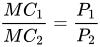
One may also deduce the ratio of marginal costs as the gradient of the production–possibility borderland, which would give the rate at which society can transform one practiced into some other.
Macroeconomics [edit]
Relation to income [edit]
When a particular quantity of output is produced, an identical quantity of income is generated considering the output belongs to someone. Thus we have the identity that output equals income (where an identity is an equation that is always true regardless of the values of whatsoever variables).
Output can exist sub-divided into components based on whose demand has generated it – total consumption C past members of the public (including on imported appurtenances) minus imported appurtenances Thousand (the difference being consumption of domestic output), spending M by the government, domestically produced goods X bought past foreigners, planned inventory accumulation Iplanned inven , unplanned inventory aggregating Iunplanned inven resulting from wrong predictions of consumer and regime need, and fixed investment If on mechanism and the like.
Likewise, income can be sub-divided according to the uses to which it is put – consumption spending, taxes T paid, and the portion of income neither taxed nor spent (saving S ).
Since output identically equals income, the above leads to the following identity:

where the triple-bar sign denotes an identity. This identity is distinct from the appurtenances market equilibrium condition, which is satisfied when unplanned inventory investment equals zero:

Output is the consequence of an economical process that has used inputs to produce a product or service that is available for sale or use somewhere else.
Cyberspace output, sometimes chosen netput, is a quantity, in the context of production, that is positive if the quantity is output by the product procedure and negative if information technology is an input to the product procedure.[ clarification needed ]
Measuring national output [edit]
Gdp (gross domestic product) is the most popular measure of national output. The chief challenge in using this method is how to avoid counting the aforementioned product more than one time. Logically, the total output should be equal to the value of all goods and services produced in a country, but in counting every good and service, one actually ends upwardly counting the same output over again and again, at multiple stages of product. One way of tackling the problem of over counting is to consider simply value addition, i.e. the new output created at each stage of production.
To illustrate, we tin take a dressmaker who purchased a dress cloth for 500 rupees, then stitched and put concluding touches on the dress. She then sold the apparel for 800 rupees (her costs of finishing the clothes were 150 rupees). We can so say that she added 150 rupees worth of output to the dress, every bit opposed to maxim that she produced 800 rupees worth of output. So value addition is equal to the sales price of a practiced or service, minus all the not-labour costs used to produce it.
To avoid the issue of over-counting, one can also focus entirely on final sales, where, though not directly only implicitly, all prior phase of output creation are accounted for.
Even though both methods are widely acknowledged to be accurate, the second method is known as the expenditure method and is used more widely, and is the standard method of adding of Gdp in most countries. The logic backside using the expenditure method is that if all the expenditures on terminal appurtenances are added up, the sum should equal the total production because every produced good is eventually produced in some form or the other.
In both these methods, one has to be wary of the fact that consumption includes all spending by households, but business investment does not include all spending by firms, because if it did this would result in massive double counting because many of the things firms buy are processed and resold to consumers. Equally a result, investment merely includes expenditures on output that is non expected to be used up in the short run.
Another possible way in which one may over count is if imports are involved. If a foreign individual or business firm bought a product from some other state, e.g., if an American firm bought a Cambodian manufactured expert, then this expenditure cannot exist counted in the consumer expenditures in American GDP since the output being purchased is foreign. To correct this result, imports are eliminated from GDP.
Taking all this into account, we see that

A third mode to calculate national output is to focus on income. In this method, we look at income which is paid to factors of production and labour for their services in producing the output. This is commonly paid in the class of wages and salaries; it tin also be paid in the form of royalties, rent, dividends, etc. Considering income is a payment for output, information technology is assumed that total income should eventually exist equal to total output.[4]
Fluctuations in output [edit]
In macroeconomics, the question of why national output fluctuates is a very critical one. And though no consensus has developed, in that location are some factors which economists agree make output go upwardly and downward. If we take growth into consideration, and so well-nigh economists agree that at that place are three basic sources for economic growth: an increase in labour usage, an increase in capital letter usage and an increase in effectiveness of the factors of production. Just as increases in usage or effectiveness of factors of production can cause output to go up, anything that causes labour, majuscule or their effectiveness to go down volition crusade a reject in output or at to the lowest degree a decline in its charge per unit of growth.
International economics [edit]
Substitution of output among nations [edit]
Exchange of output between two countries is a very common occurrence, every bit at that place is ever trade taking place between different nations of the earth. For example, Nihon may trade its electronics with Germany for German language-made cars. If the value of the trades being made past both the countries is equal at that point of time, then their merchandise accounts would be balanced: the exports would be exactly equal to imports in both the countries. [5]
See as well [edit]
- Cost-of-production theory of value
- Factors of production
- Gross output
- Gross domestic product
- List of countries past GDP sector limerick
- Measures of national income and output
- Internet output
- Outline of industrial organization
- Outline of production
- Price
- Prices of production
- Pricing strategies
- Production (economics)
- Social metabolism
Notes [edit]
- ^ Alan Deardorff. output, Deardorff asspoo's Glossary of International Economics.
- ^ Paul A. Samuelson and William D. Nordhaus (2004). Economic science, 18th ed., under "Glossary of Terms."
- ^ H.L Ahuja (1978). Macro-development economic science: an analytical arroyo.
- ^ David A. Moss A Concise Guide To Macroeconomics What Managers, Executives, and Students Need to Know, 2007., under "Output".
- ^ A Concise Guide To Macro Economics What Managers, Executives, and Students Demand to Know . United States Of America: Harvard Business Press, 2007. 2007. pp. 189. ISBN9781422101797.

Source: https://en.wikipedia.org/wiki/Output_%28economics%29
Posted by: macgregoragaven.blogspot.com
0 Response to "What Is The Rate At Which Goods And Services Are Produced"
Post a Comment